
Before Coming to NAIST
My background before coming to NAIST was in mathematics — I studied applied mathematics at the undergraduate level. My graduation thesis was related to meteorology, dealing with atmospheric gravity waves. For my master's degree, I majored Computational and Industrial Mathematics at (University of Khartoum). I believe the methods I used at that time became the trigger for my interest in neuroscience and mathematical modeling.
Back then, I subscribed to a magazine called "Scholarship Positions" to get information about scholarships, and that's where I came across NAIST. I believe I was the first Sudanese person to come to NAIST.
NAIST's website had information about the faculty supervisors in each lab, and I first contacted Professor Ikeda by email. I failed my first entrance exam, likely because my research plan was missing an important element. After that, under his guidance, I tried again, passed, and was able to come to Japan.
Coming to Japan is, I believe, the best thing that has ever happened in my life. I had always wanted to come to Japan. I had originally been drawn to Japanese culture — its advanced technology, nature, ethics, manners and mutual respect. During my university years, my interest in the culture and in anime deepened through Japanese and Japanese mixed-heritage friends, and I found a Japanese teacher (a woman who had married a Sudanese man and lived in Sudan for nearly 20 years) and began studying with her. After that, as a result of negotiations with the embassy, a Japanese language major was established at the University of Khartoum, and I was able to take formal classes.
What interests me in particular is how much Japanese people value their work. I'm struck by the attitude of always giving one's best effort even when no one is watching, and by the ability to maintain that energy even into old age. In Sudan, average life expectancy is around 40 to 60, hereditary illnesses like diabetes and hypertension are common, and there is a cultural tendency, once you pass 50, to become more conscious of "death" than of "living." That's precisely why it feels so refreshing to see Japanese people sustain their motivation over so many years and continue to be grateful for their role.
I also sense a difference between the older generation, like my supervisor, and the younger members of the lab. The younger generation certainly has a sense of responsibility and independence, but I feel there is something special — in terms of dedication to work and vitality — about Japanese people over 60.
My Current Research and Research Life
After completing my master's degree, I worked for a year as a tutor in the Faculty of Engineering at the University of Khartoum. I then joined the National Institute of Endemic Diseases as a research assistant. This was a valuable experience for me because it gave me the opportunity to work in a research environment and develop practical research skills. However, research funding was very limited, and the system was unstable. In some cases, researchers were only paid after publishing a paper, which meant that I could work for six months or more before receiving any salary. Although I valued the research experience, it was financially difficult to rely on research alone as a source of income.
To support myself, I took on several jobs at the same time—as a mathematics teacher, private tutor, and lecturer at private and international schools—while also holding another full-time job. I did not dislike teaching itself; in fact, I enjoyed many aspects of it. However, I always had the feeling that what I truly wanted to pursue was research, and that I was continually being pulled back into teaching because it was more financially sustainable.
When my children were one and three years old, this became particularly challenging. At the same time, my husband was working alone in Saudi Arabia, so I was managing work, childcare, and household responsibilities largely on my own. I was so consumed by these responsibilities that I barely remember that period of my life.
After about two years of juggling multiple jobs with almost no ability to save money, I passed the NAIST entrance exam. When I told my husband, he returned from Saudi Arabia, and after going through visa applications and other procedures, our whole family came to Japan in November 2022 — about six weeks after the fall semester had already begun. Now I finally feel that I am on the path of the research I was truly interested in.
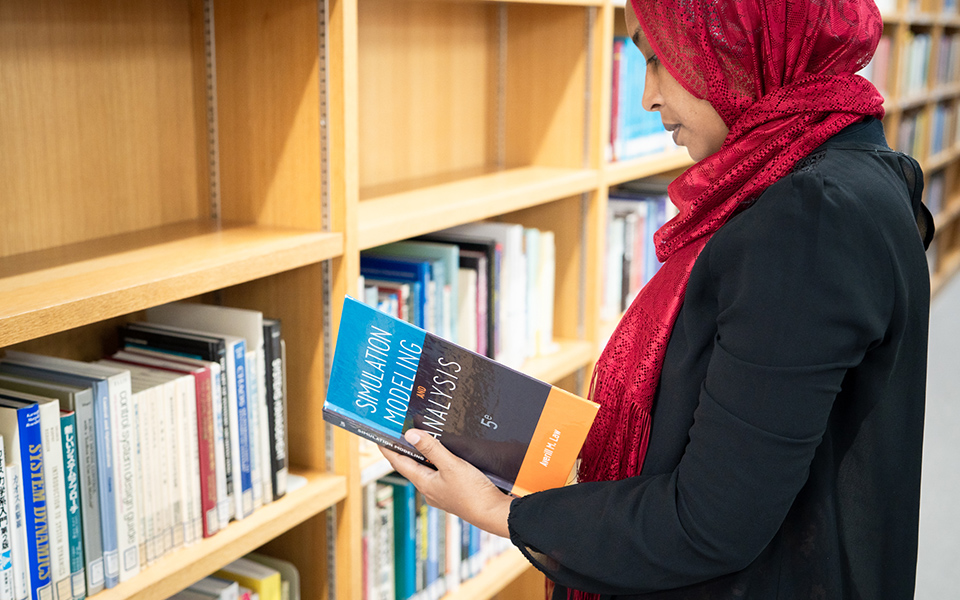
My current research theme is modeling research related to psychiatry, and the reason I ended up here is that I lost several friends and family members to mental health problems. In my master's program, my theme was applying optimal control to mood models of bipolar disorder, and I worked on the question of why people don't return to their healthy state even after receiving treatment.
Since coming to NAIST, I've worked on the theme of the "addicted brain." Even when their life improves, people with mental illnesses often cannot stop taking their medication, because stopping causes withdrawal symptoms — so they keep taking the medication just to maintain a certain state. I became interested in this cycle. From there, the "addicted brain" theme developed into representing, through a mathematical model, the stress management of people with a certain specific disorder. The difficulty of reducing medication or treatment is a challenge common to mental health fields in every country. With cancer, some people recover and are able to stop treatment, but I feel that mental health care still hasn't had that kind of breakthrough.
I've also had an interest in the history of mathematics since my undergraduate days. Following the history of mathematics reveals why a particular topic emerged in a specific field — economics or medicine, for example — and developed together with mathematics. New mathematical methods get applied to solving problems in other fields, and science and mathematics gradually become integrated as they develop — and I think that process is what leads to the discovery of new solutions and new problems.
There's still a lot of effort needed to discover and solve problems, and better models are still needed, but even an immature idea has to be given some form first, or there will never be a chance to improve it. There are times when I feel my own ideas aren't very good, but nothing improves unless you voice them and start working on them. I think taking that first step is what matters most.
I remember the first time I showed my supervisors my ideas in a slideshow. Professor Ikeda, Professor Yoshimoto, and Professor Kubo gave me advice on questions that would make the theme more interesting, and on ways to work toward solving it. This is the kind of support I've received at NAIST.
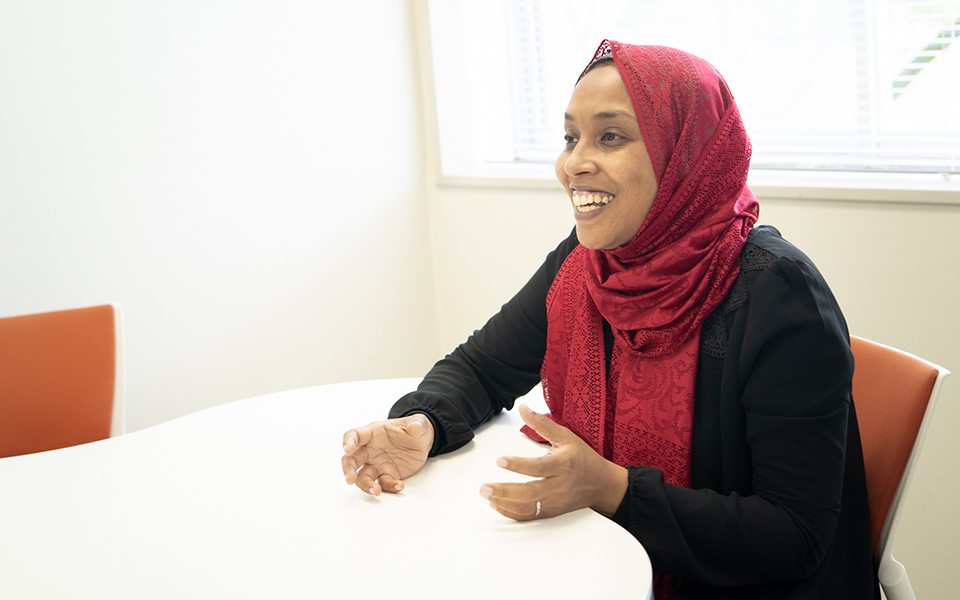
Challenges in the Research Environment
NAIST's location isn't very convenient for shopping trips to Osaka and elsewhere, but I really like this environment because I prefer quiet places. I can't stay in lively places for long, so if I start missing that, a single day trip to Osaka is enough to satisfy me.
When I first arrived in Japan, I was worried about whether I'd be able to communicate in English, but from the moment I arrived at Kansai Airport, many people helped us, and we were never left alone until we got out of the airport. After coming to Japan, I also had a tutor assigned by the Lab who accompanied me to city hall and helped with various procedures, which was a huge help.
Something I wish NAIST had is an international event held every year—one that would bring together not only graduates and current students, but also supervisors and researchers involved in exchange programs, as well as people from different fields and backgrounds. It could provide an opportunity for participants to introduce their research, exchange ideas, and build connections beyond their immediate academic communities. Rather than being another Expo, I imagine something more interactive and focused on networking and dialogue, where the younger generation—including my own children and junior high and high school students—could meet researchers and professionals and broaden their perspectives on science, technology, and the possibilities available to them in the future. Beyond existing exchange programs, such an event could also give students who may not have the opportunity to study abroad a chance to connect with people from different countries, cultures, and fields, and to discover perspectives and opportunities they might otherwise never encounter.
I haven't really begun working on this in earnest yet, but going forward, I'd like to find some way to build a connection between my home country and NAIST. As you may know, war broke out in Sudan in April 2023. The research institute where I had worked had carefully protected a vast amount of epidemiological data since 1991, but when the war began, the facility was seized, and much of the valuable research accumulated over many years was lost. The entire education system was affected, and every university library was burned down. People have lost things that mattered deeply to them, and are profoundly devastated. I myself lost a mentor. He always used to say that his personal library was bigger than the university's, because he loved books so much — but he was attacked in his home in the capital. Because of things like this, many people have lost the will to resume their research. I don't think a genuine rebuilding of research will be possible until the war ends.
I go to see a counselor at the university so that I don't let the stress build up. Back in my home country, my whole family and my husband's whole family were forced out of their homes at gunpoint, which was an extremely difficult experience. Many people were displaced, and when education and work came to a complete halt, large numbers of families were forced to leave Sudan. Friends whose children were still in school had no choice but to move abroad—to the Gulf states, Egypt, and elsewhere—so that their children's education could continue. We haven't been able to return home even once since we came here in November 2022, and I still worry about my family and friends constantly. Recently, however, there have been some signs of improvement in the security situation in parts of Sudan, which gives us some hope for the future. I sincerely hope that this progress continues, that people can gradually return to their homes, and that families can rebuild their lives and children can return to school. For me, the possibility of eventually returning home and seeing Sudan become peaceful again is something I continue to hope for.