
Before Coming to NAIST
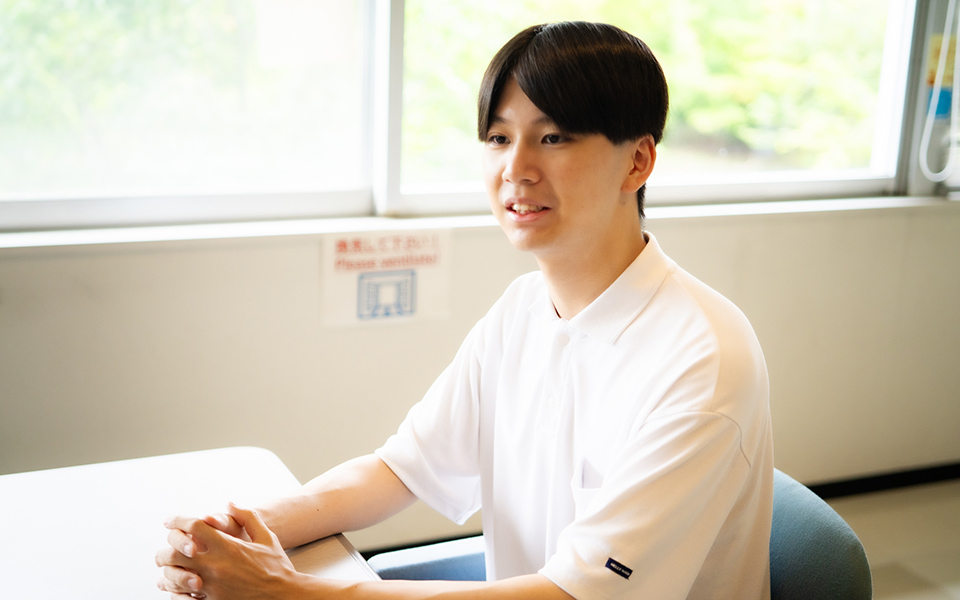
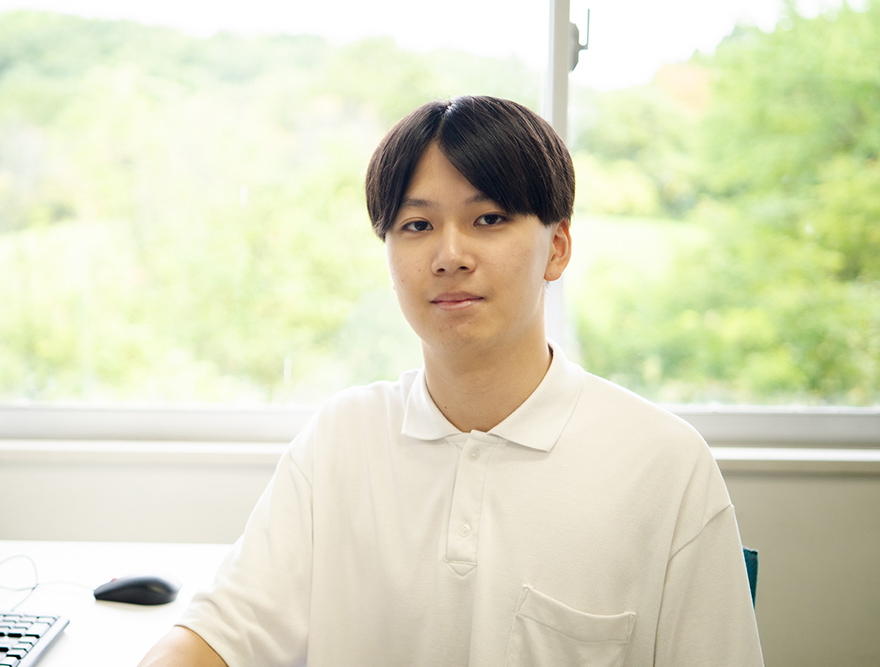
I graduated from the Department of Electrical and Electronic Engineering, Faculty of Science and Engineering, at Yamato University. In the spring right after becoming a third-year undergraduate, I attended a NAIST open campus event and, while visiting booths for laboratories in the Division of Materials Science, I became strongly interested in the laser light being used by the lab I now belong to.
Many students at Yamato University who are interested in graduate school consider either NAIST or JAIST, and I was the same—that's why I attended the open campus. I think it also had an influence that a senior from the same lab, one year above me, was aiming for NAIST.
At the time I still hadn't decided whether to go to graduate school or find a job, but the student running the booth at NAIST spoke so passionately about their own research that I thought, "I want to be the one talking about my research too—research looks fun," and that pushed me toward continuing my studies.
After that, in the summer of my third year, I did a two-week internship at the Bio-Process Engineering Laboratory in the Division of Materials Science. In March I took the recommendation-based entrance exam, and from the spring of my fourth year I was enrolled as a special research student (tokubetsu gakushusei). Thanks to this, I was able to spend my final undergraduate year doing research at my own pace, without being chased by graduate entrance exam preparation.
Yamato University and NAIST are partner/affiliated institutions, and every year, one or two special research students from Yamato have joined our division. As a special research student, I stayed at the lab three to four days a week, about four to five hours a day, and worked on my undergraduate thesis research under the guidance of Professors Hosokawa and Tsuri.
Current Research and Research Life
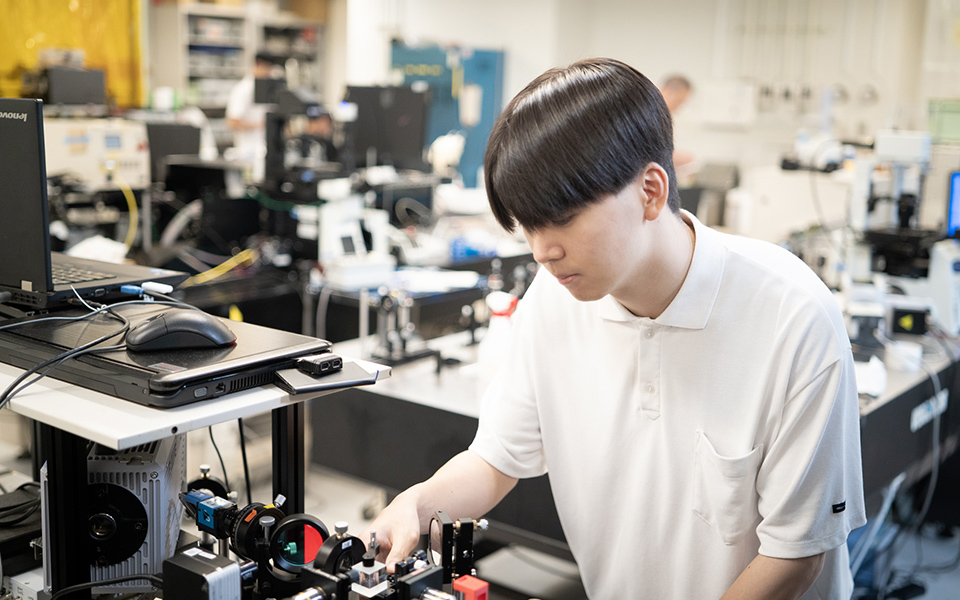
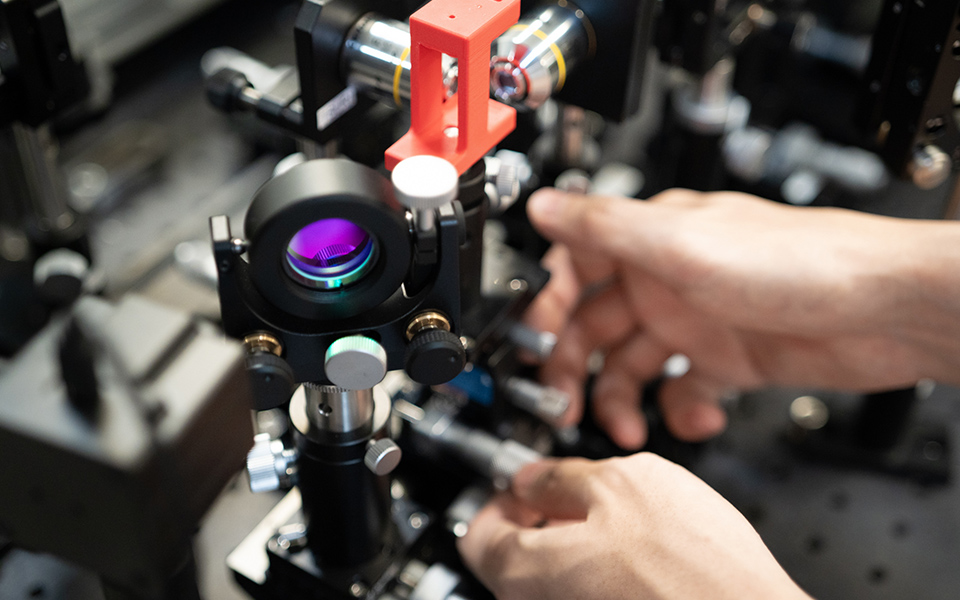
I'm currently doing research using a special type of laser called a femtosecond laser. By irradiating a solution—water with a solute such as salt or protein dissolved in it—with laser light, I observe the phenomenon of crystallization occurring. Crystallization refers to the process in which solutes dissolved in the solution, such as salt or protein, forming crystals, and I use image analysis to observe the changes in concentration that occur during this process.
I originally had an interest in lasers themselves. Even though a laser doesn't make direct physical contact, it can affect matter—it can even be used for metal processing. This lab explores various uses of lasers, including irradiating cells to detach them, and I find that fascinating. Before entering the master's program, Professor Hosokawa suggested to me that there's a field involving using lasers to create crystals, and asked if I'd like to try it. That's what I'm currently working on.
Compared to my undergraduate lab, this lab has more research space and larger-scale equipment. There are also technical staff members, so I feel the research environment is well-equipped and makes it easy to progress in research.
In our lab, it's an annual tradition for first-year master's students to give poster presentations at an international conference held in Taiwan, and I'm currently preparing for that. Many others present at various other conferences as well; I don't have any such plans yet, but if the opportunity comes up, I'd like to keep building my skills so I can present with confidence.
I find the coursework difficult, but since much of it—such as materials chemistry—directly relates to and benefits my research, I'm quite motivated to attend classes. Rather than general education courses, most of what's offered goes deep into specialized content, so I'm able to take courses I genuinely want to learn about. The schedule tends to be tight, and I stay busy, but in that sense, my days feel fulfilling.
I think NAIST is a place that will respond to you if you have the motivation. For those considering going to graduate school, I'd suggest having a conversation with yourself about what your own motivation actually is. Whether or not you're capable of the coursework matters, of course, but in the end, I think it really comes down to your drive—your willingness.
I majored in electrical and electronic engineering through my undergraduate years, but in graduate school I ended up starting research dealing with crystals—which intersects with the field of chemistry. I hadn't had much exposure to chemistry before; I didn't even take chemistry in high school. In that sense, chemistry was something I had actually avoided. So as soon as I was offered the chance to "try crystals," I started studying from the very basics, asking myself: "What even is a crystal?" Prof Tsuri introduced me to some reference books that explain the fundamentals and even lent me some, which I read intensively and did my best to absorb. Now I feel I've reached the point where, even when I read papers on prior research, I don't find myself completely lost as to what they mean.
As for whether I've hit any walls while pushing my research forward—I don't think I really have. When I feel I can't do something, I'm the type of person who consults someone right away. I'm not sure if it's because my starting position in the lab was as a special research student, but I've kept the approach of trying something first, and then consulting someone when I hit a wall—and that's worked out for me so far. In that sense, people who tend to bottle things up and try to handle everything alone might be a bit at risk.
My current lab isn't the type where instructions come one after another from the professors; rather, it's the type that responds when you ask. So, in that sense, you have to be proactive and act on your own initiative. That's why I think it's important to keep looking at, and searching for, what you yourself are lacking. You need the ability to judge for yourself when it's the right moment to go ask for advice.
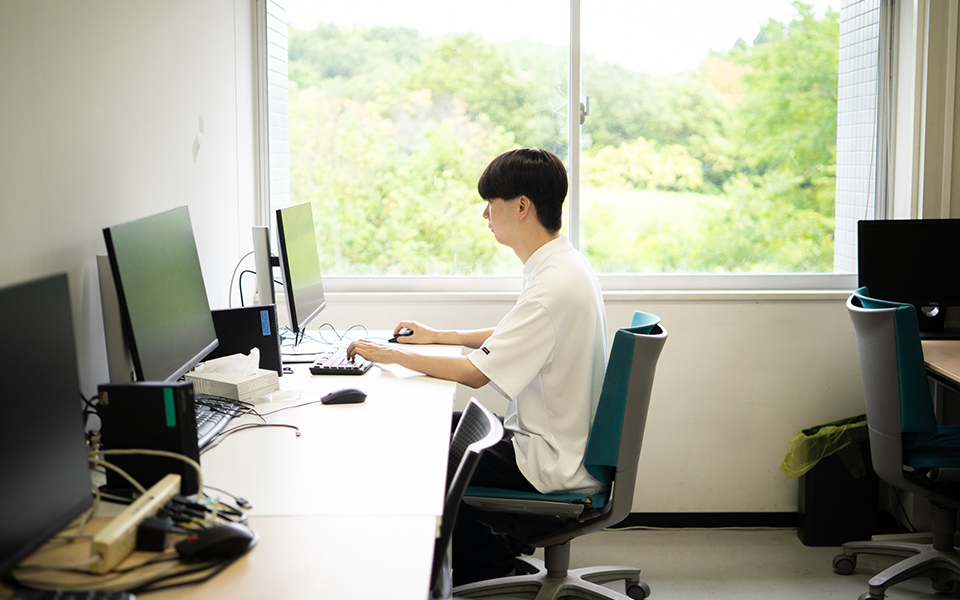
Challenges in the Research Environment
I live in the dormitory, and living there means you end up relying on the supermarket near the train station for daily necessities. In that sense, I do sometimes wish more of that could be self-contained within campus. I get around by bicycle for shopping, but I imagine there are international students who can't ride a bicycle. Looking at the road to the station, I see a lot of international students walking the round trip on foot, so I think they may be experiencing some inconvenience in that regard.
Also, there aren't really many spaces on campus to relax—no shared common spaces, no cafés, etc. As a place to do research, I don't feel much inconvenience or dissatisfaction, but for those of us living in the dorm, where our time here is also literally our daily living situation, I think small dissatisfactions—a sense of something missing—tends to build up.
In addition, living in the dorm means your daily life can end up being just a back-and-forth between the lab and the dorm, so there are few opportunities to get physical exercise. I heard that there used to be a gym on campus some years ago, but it no longer exists, so I do wish there were a place where we could exercise casually on our own.