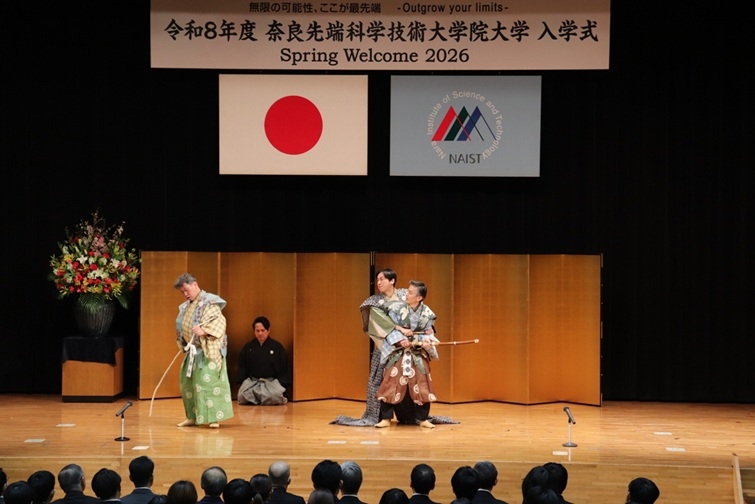


On Monday, April 6, the 2026 Spring Welcome was held in the Millennium Hall.
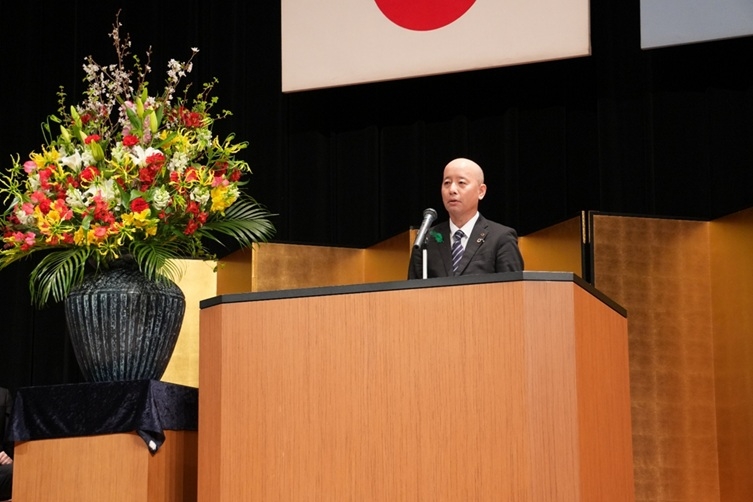
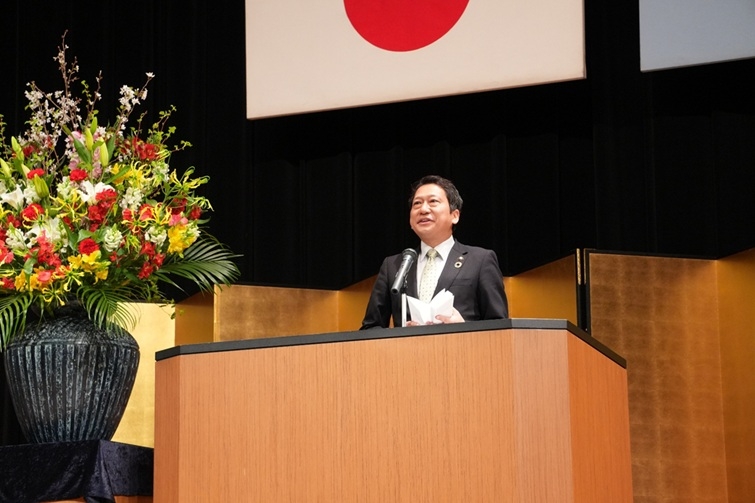
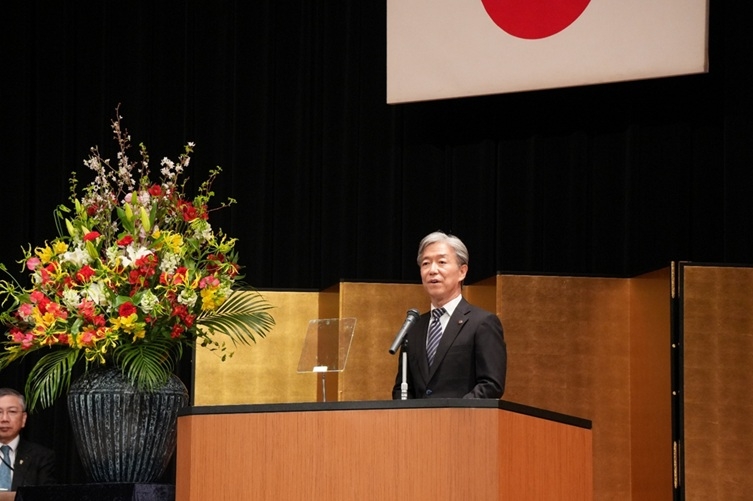
At the ceremony, President SHIOZAKI Kazuhiro gave congratulatory speeches, and the congratulatory messages from Mr. YAMASHITA makoto, the governor of Nara prefecture, Mr. KOMURASAKI Masashi, the mayor of Ikoma City, and Dr. NISHIO Shojiro, Director-General of the International Institute for Advanced Studies were given to new students.
At the end of the ceremony, a kyogen performance was played by the Ookura Ryuu which attracted all the attendees.
【Master's Course】
Graduate school of Science and Technology 378 (41 international students)
Graduate school of Science and Technology 77 (25 international students)
【Congratulatory speeches President of NAIST】
2026 Spring Welcome
On behalf of the faculty and staff of Nara Institute of Science and Technology, I would like to extend my heartfelt congratulations to the 378 students who have enrolled in our Master's programs and the 77 students who have enrolled or advanced to our Doctoral programs today, as well as to their families. I would also like to express my sincere gratitude to Mr. Makoto Yamashita, the Governor of Nara Prefecture, Mr. Masashi Komurasaki, the City Mayor of Ikoma, and Dr. Shojiro Nishio, Director-General of the International Institute for Advanced Studies, for their congratulatory addresses today.
Today marks a meaningful and celebratory new start for you because each of you has taken the step to further your learning in graduate school. Our faculty and staff are proud that you have chosen NAIST as the place to pursue your graduate education, and we hope that you, too, take pride in studying here. In the latest evaluation by the Ministry of Education, Culture, Sports, Science and Technology, NAIST was one of only two national universities in Japan to receive the highest rating in both "education" and "research" categories. In addition, NAIST has been selected as one of 25 universities for the ministry's new funding program, J-PEAKS, which allows us to develop a next-generation research university model, starting in April last year. NAIST continues to pursue the cutting edge in research and education, and such a campus environment should encourage you to explore your potential.
Now, the rock band RADWIMPS has a song called "Seikai (Right Answer)," which has recently become popular at graduation ceremonies. You may wonder why I'm mentioning a graduation song at an entrance ceremony. I want to point you to the following message in the song:
"Every question we'd been taught had an answer.
Is that why? No grown-ups have the right answer to what we really want to know."
The studies you will undertake in graduate school will be very different from what you have experienced as an undergraduate or in technical junior college, where you have mainly learned "questions that have answers." However, at NAIST, you will learn through engaging in cutting-edge research, a challenge aimed at acquiring knowledge and technologies yet unknown to humankind. "No grown-ups have the right answer" in such research, including professors. For example, Prof. Shinya Yamanaka and his graduate students at NAIST worked to establish iPS cells, a challenge no one knew was possible. As you know, however, their success was later recognized with a Nobel Prize. I invite you to visit the Large Lecture Hall in our Division of Biological Science building. By the entrance door of the lecture hall, you can read a message from Prof. Yamanaka on a brass plaque that commemorates his Nobel Prize. There he says:
In baseball, players with a batting average of 30% are considered great. But in research, a 10% success rate is excellent. In addition, the tenth successful attempt cannot usually be performed until the nine unsuccessful attempts have been completed. So, without fear of what will result, try your hardest and make mistakes.
By saying "a 10% success rate is excellent," Prof. Yamanaka meant that the actual success rate might be below 10%. It could be 1% or 0.1%. As you keep trying on a research project without success, you may start feeling lost and desperate. Eminent systems biologist Uri Alon referred to such a situation as "the cloud." A pilot flying in clouds cannot see where they are going and loses their sense of direction. Professor Alon says this cloud is an inherent part of research, standing between the known and the unknown. Therefore, to reach the unknown, which is a discovery, we must plunge into "the cloud". You may wonder how to navigate the blinding cloud that hinders your discovery. Professor Alon suggests that solidarity and support can help to get out of the cloud.
At NAIST, you will join a laboratory. Let me reiterate that, at the forefront of scientific and technological research, you are attempting to accomplish something no one has ever done before. Even your professors do not know the exact route through the cloud or what discoveries await beyond it. However, they are experienced copilots who are willing to fly through "the cloud" with you. Our faculty members are world-class researchers and look forward to collaborating with you.
With the help of your professors and colleagues in the laboratory, you try, try, and try to go through the turbulent stormy cloud. Suddenly, you come to a calm, blue sky, where you catch your first glimpse of an unexpected discovery. Such an experience in graduate study will equip you with abilities and skills that expand your potential across diverse contexts of your life, as our school motto succinctly states: Outgrow your limits.
A number of exciting laboratories are just part of the remarkable environment of our campus that allows you to "Outgrow your limits." This is a place where you can discover new possibilities within yourself, overcome your perceived limitations, and foster personal growth.
Welcome to NAIST!
April 6, 2026
Kaz Shiozaki
President