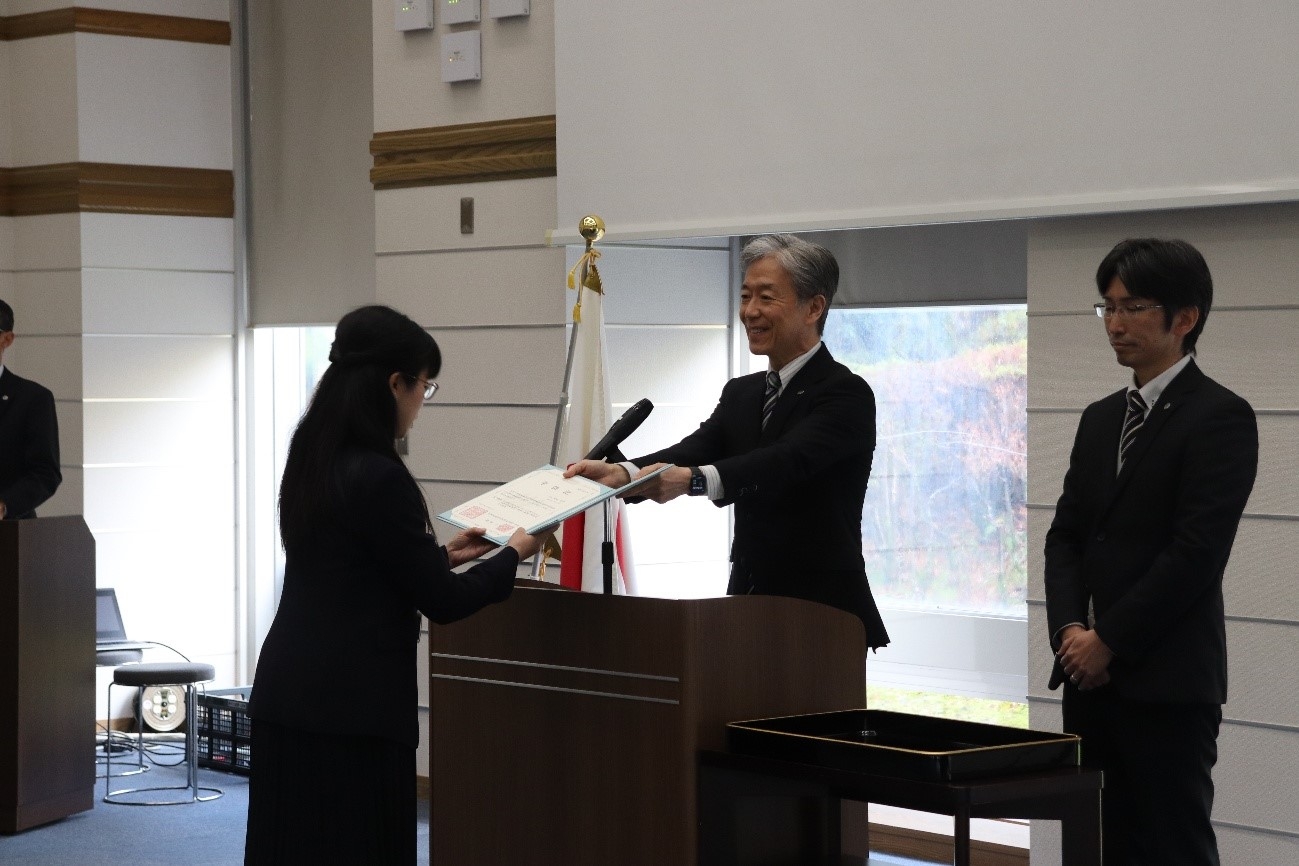
12月22日(月曜日)、学際融合領域研究棟2号館1階TAKASAGO研修ホールにおいて学位記授与式を挙行しました。
授与式では、塩﨑一裕学長から修了生に学位記が手渡され、門出を祝して英語で式辞が述べられました。
当日は式典終了後の会場を記念撮影のために開放し、修了生及びご家族は和やかな雰囲気のもと歓談し、喜びを分かち合いました。
※ 今回の修了生の内訳は、以下のとおりです。
【博士後期課程修了者】
先端科学技術研究科 2名〈うち留学生 1名〉
計 2名(うち留学生1名)
【Congratulatory Remarks to Graduating Students】
President's Commencement Address (December, 2025)
Let me begin by offering my sincere congratulations to both of you, who have just been conferred doctoral degrees. With commendable enthusiasm and perseverance, you have been striving toward one of the life milestones you have reached today. We could not be prouder. Well done!
Today, we have assembled here to celebrate your hard work and remarkable achievements. But you did not do them alone. Let's take a moment to think of everyone who has supported and stood by you during your time at NAIST: your parents, family, friends, professors, and our staff--my heartfelt salute to them.
Having obtained a doctorate today, the highest academic degree, you are about to step into the next stage of your life. It is a significant and interesting transition. For more than 20 years, since elementary school, you have been taught, guided, and supervised by teachers and professors. But after finishing graduate school, there is no more school to go to, except traffic school.
In Japanese martial arts and performing arts, there are three stages of training and learning, called Shu (守), Ha (破), and Ri (離). The concept of Shu-Ha-Ri is said to have originated from the teachings of Sen no Rikyu (千利休), a renowned tea ceremony master in 16th-century Japan. The first stage, Shu, is represented by a Chinese character that means "guard," "keep," or "follow." Indeed, in this early period of learning, you try to follow what your master or teacher instructs, keeping and obeying the way you are taught. Our learning up to the undergraduate level may correspond to the stage of "Shu."
The next stage of learning, "Ha," is written in a Chinese character meaning "break," as it is a phase of breaking the shell. You start exploring other approaches, styles, and views, seeking what you prefer over what you have learned from your teacher or textbook. I would say your graduate study at NAIST corresponds to this phase. In addition to your professor's supervision, you read papers by other researchers and discuss research with your fellow colleagues. By trying different combinations of approaches and styles of your professor and other researchers, or modifying them, you seek new ways to "break" the existing frameworks and establish a better one.
The last stage of Shu-Ha-Ri is "Ri." The word means "leave" or "stray from." Having mastered what you were taught and become well-versed with the discipline you explored, you are now ready to leave your professor's school of thought and freely pursue your own style, approach, and mission in life. The doctoral degree you received today is a certificate that you are qualified for this stage of "Ri." You now depart from your professors and NAIST to start your own quest.
As I mentioned earlier, the concept of "Shu-Ha-Ri" comes from a lesson by Sen no Rikyu. The original saying was, "Never forget the fundamentals, even if you break or stray from the precept after strictly following it." So, what the Japanese tea ceremony master emphasized was the importance of fundamentals. Before departing from NAIST, I want you to think about what the "fundamentals" you learned here are that you should carry with you into your future career. Of course, they are different from those in the Japanese tea ceremony.
At NAIST, you studied in a particular laboratory and conducted a specialized thesis project. Importantly, they have served as an excellent platform to acquire skills and abilities that can be applied to a wide array of tasks, issues, and problems. Such skills and abilities are sometimes called "transferable skills" because they can be applied across diverse contexts and help identify solutions.
The transferable skills, such as ways to objectively observe, logically think, and critically evaluate thinking of your own and others, are the "fundamentals" that you should never forget. By tackling different problems and tasks with those skills, you can continue to evolve even after you leave NAIST. That's how you enjoy the final stage of "Shu-Ha-Ri."
Congratulations again to both of you, our newest alumni. Today, you are joining over 10,000 alumni who have also been trained here at NAIST and are trying to make this world a better place. The NAIST Alumni Association is a global network for our graduates. I encourage you to participate actively in it and stay connected with NAIST. Even after graduation, you remain a member of the NAIST community.
Let me close my commencement address with my parting wish for you: May your future be rewarding and fulfilling! Have fun!
Kaz Shiozaki
President
【学長式辞】
※参考 日本語訳
このたび博士号を授与されたお二人に、心よりお祝い申し上げます。素晴らしい情熱と粘り強さをもって努力を重ね、本日、人生の大きな節目の一つに到達されたあなた方を心から誇りに思います。本当におめでとうございます。
今日はお二人のこれまでの努力と輝かしい成果を祝うために、ここに集まったわけですが、それも決して自分の力だけで成し遂げたわけではありません。NAISTでの学生生活を通じて、あなた方を支え、寄り添ってきた多くの方々―ご両親、ご家族、ご友人、指導教員、そして本学職員の存在があったと思います。私からも深い敬意と感謝を表したいと思います。
本日、最高学位である博士号を取得されたお二人は、これから人生の次のステージへと踏み出すわけです。これはとても大切で、かつ興味深い転換点なのです。お二人は小学校以来、20年以上にわたって、教師や教授から学び、導かれ、指導を受けてきました。しかし大学院を修了してしまうと、今後、授業を受けることがあるとしても交通違反者講習ぐらいです。
さて、日本の武道や芸能の世界には、「守・破・離(しゅ・は・り)」と呼ばれる修行・学びの三段階があります。この守破離の概念は、16世紀の茶道の大家である千利休の教えに由来すると言われています。第一段階の「守」という漢字は、「守る」「保つ」「従う」といったような意味です。この初期段階では、師匠や教師の教えを忠実に守り、その型に従うことを身に付けます。学校における学習で言うなら、大学の学部課程までの学びは、この「守」の段階に相当するように思います。
次の段階である「破」は、「破る」という意味の漢字で、いわゆる殻を破る段階です。この段階では、師や教科書から学んだことだけに留まらず、他のアプローチや型、視点を探求し始めます。あなた方がNAISTで受けた大学院教育は、この「破」に当たるのではないでしょうか。教授の指導を受けるだけでなく、他の研究者の論文も読み、研究仲間たちと議論を重ねてきたと思います。指導教員や他の研究者のアプローチやスタイルを組み合わせたり、修正したりしながら、既存の枠組みを「破」り、より良いものへと至る新しい道を探ってきたことでしょう。
守破離の最後の段階が「離」です。「離」は「離れる」「逸脱する」というような意味を持ちます。教えられたことを十分に身につけ、探求してきた分野に精通した今、お二人は指導教授の考え方から離れ、自分自身のスタイル、アプローチ、そして自らの人生の使命を自由に追求する準備を整えました。本日授与された博士号は、あなた方がこの「離」の段階に進む資格を得たことを示す証です。これからお二人は、指導教員とNAISTから巣立ち、それぞれの探求の旅を始めるのです。
先ほど申し上げたように、「守破離」は千利休の教えに由来しています。その元々の文言は、「規矩作法 守り尽くして破るとも 離るるとても本を忘るな」というものです。つまり、この茶道の宗匠が強調したのは「本」、すなわち基本の重要性でした。NAISTから旅立つにあたり、お二人がここで学んで今後のキャリアのために身に付けた「基本」とは何かを考えてほしいと思います。もちろん、それは茶道の基本とは異なります。
NAISTでは、お二人は特定の研究室に所属し、専門性の高い学位論文研究に取り組んできました。その過程は、さまざまな課題や問題に応用可能な技能や能力を身につけるための優れた学びの場でもありました。そのような技能や能力は、幅広い状況に活用できることから、「トランスファラブル・スキル(汎用的能力)」とも呼ばれます。
客観的に物事を観察する力、論理的に思考する力、自分や他者の考えを批判的に評価する力-こうしたトランスファラブル・スキルこそが、お二人が決して忘れてはならない「基本」です。これらの力を用いてさまざまな問題や課題に取り組むことで、お二人はNAISTを離れた後も成長し続けることができます。そのようにして、「守破離」の最終段階である「離」を経験し、楽しむことができるのです。
改めて、本学修了生となったばかりのお二人にお祝いを申し上げたいと思います。今日、あなた方は、これまでにNAISTで学び、この世界をより良くしようとしている1万人を超える同窓生の仲間入りを果たしました。NAIST同窓会は、世界中に広がる修了生のネットワークです。ぜひ積極的に参加し、NAISTとのつながりを大切にしてください。修了後も、お二人はNAISTコミュニティの一員です。
最後に、お二人の前途が実り多く、充実したものとなることを祈念して、私の式辞といたします。
2025年12月22日
奈良先端科学技術大学院大学
学長 塩﨑 一裕